blogs
A Case for Holistic Design
Parag Natekar | March 13, 2026
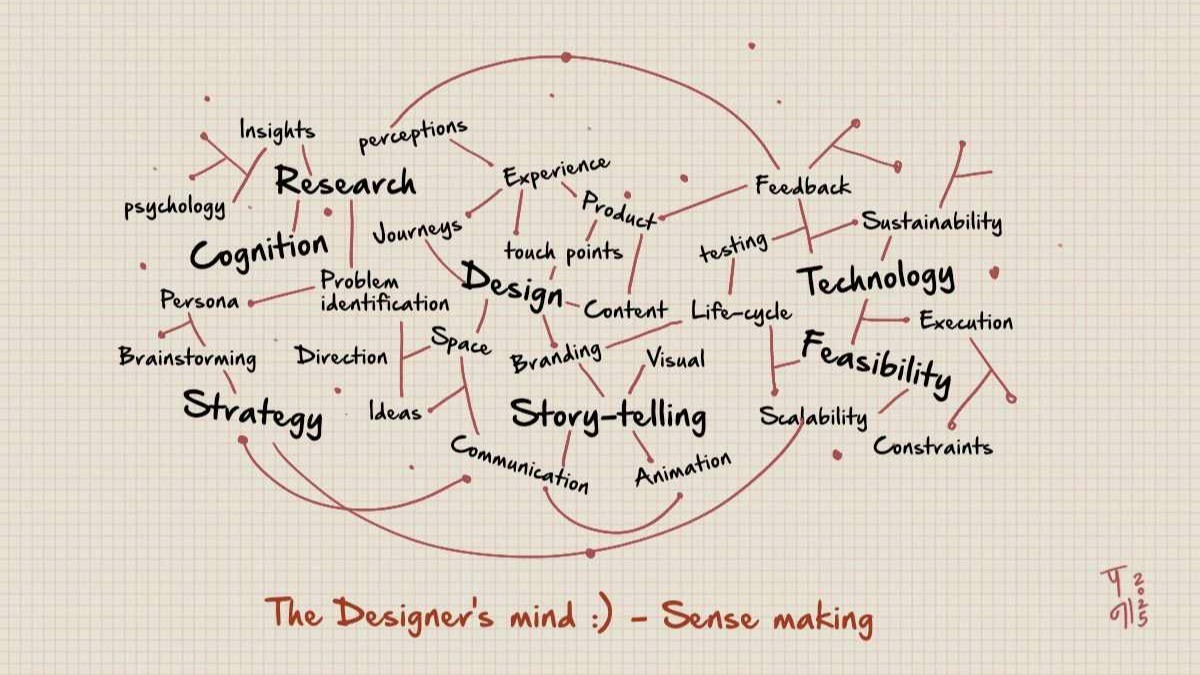
UX, visual, motion, communication; we love labelling design.
But users never experience design in parts.
I’ve never been comfortable calling myself just a UX designer, a visual designer, a motion designer, or a game designer. Those labels always felt incomplete. Early in my career, I struggled to fit into roles that were neatly compartmentalised. Even though I was more oriented towards visual design and animation, I never felt I was only that. I was equally curious about and capable of research, interaction, motion, communication, and more.
I never quite belonged to one box. And over time, I realised that wasn’t a limitation. it was a way of seeing.
Design as a Continuous Whole
Design never felt fragmented to me. It felt continuous.
Think of a banyan tree.
There isn’t a single trunk that everything depends on. Roots grow into branches, branches become trunks, and supports appear where they’re needed. Everything is interconnected, growing over time, holding the whole together.
You can’t isolate one root and say this alone keeps the tree alive. It’s the system of connections that gives it strength.
That’s how people experience design too. Their understanding is shaped simultaneously by research insights, interaction flows, visual language, motion, tone, and communication. You can separate these on an org chart, but in real life they collapse into one experience.
That cognition between research, interaction, motion, and communication is what makes an experience feel alive. A designer needs to be able to sense and shape that whole not just execute one part of it.

How the Industry Often Sees Design
Over time, the industry chose convenience over coherence.
Design became easier to manage when it was broken into roles, departments, and deliverables. UX here. Visual there. Motion somewhere else. Communication handled separately.
This structure may have made hiring, budgeting, and scaling simpler. But it also quietly changed how design itself is understood especially in corporate and services environments.
Design began to be seen as a set of functions, rather than a way of thinking. Success became tied to outputs, tools, and speed. Craft started being measured in isolation, not in how well things came together.
In this framing, coherence often becomes nobody’s responsibility because everyone is “doing their part.”
How Many Young Designers Come to See Design
This fragmentation doesn’t stop at the organisational level.
It also shapes how many young designers learn to see themselves largely because this is how the industry demands it. Many enter the field believing they must choose a box early: UX designer. Visual designer. Motion designer.
They begin measuring their worth through tools, titles, and narrow skill stacks. Curiosity beyond the defined role is often discouraged or seen as dilution rather than depth.
I’ve seen young designers either feel anxious about not fitting cleanly into one category, or become rigid in their understanding of what design is. Some stop asking broader questions because they feel it’s “not their place.” Others rush to specialise before they’ve had time to understand the whole.
What often gets lost early is the confidence to think beyond immediate output to see design as sense-making, not just execution.
What It Means to See Design Holistically
Holistic design doesn’t mean doing everything yourself. It means understanding how everything connects.
It means designing with awareness of the whole, even when you’re responsible for only one part.
At Studio Vitamin D, this belief shapes how we work. Clients may approach us for UX and end up rethinking their communication or brand or come in for communication and uncover deeper product or experience gaps. Within the team, we encourage everyone to think like product designers, not isolated specialists.
Because fragmentation rarely comes from users. It comes from organisations. Job titles, org charts, scopes, and deliverables slowly define what design is “supposed” to be. Over time, designers begin to say, “This isn’t my scope” or “I’ll just do my part.”
That mindset may protect boundaries, but it weakens ownership.
Design was never meant to be a set of isolated disciplines. It was always about making sense of the world for others.
Specialisation will continue and that’s fine. But without holistic thinking, it turns into silos.
The richness of design doesn’t lie in sharper compartments. It lies in designers who can connect disciplines, hold complexity, and create coherent experiences.
That’s not a role. That’s a way of seeing.
#HolisticDesign #DesignPhilosophy #DesignThinking #SenseMaking #ExperienceDesign #SystemsThinking #DesignLeadership #CreativePractice #DesignCulture
© 2025 Studio Vitamin-D Pvt. Ltd.

great things start with a conversation !
© 2025 Studio Vitamin-D Pvt. Ltd.
Blogs
blogs
Ramen
A Case for Holistic Design
A Case for Holistic Design
A story about ramen and it impact on history
Parag Natekar | March 13, 2026
UX, visual, motion, communication; we love labelling design.
But users never experience design in parts.
I’ve never been comfortable calling myself just a UX designer, a visual designer, a motion designer, or a game designer. Those labels always felt incomplete. Early in my career, I struggled to fit into roles that were neatly compartmentalised. Even though I was more oriented towards visual design and animation, I never felt I was only that. I was equally curious about and capable of research, interaction, motion, communication, and more.
I never quite belonged to one box. And over time, I realised that wasn’t a limitation. it was a way of seeing.
UX, visual, motion, communication; we love labelling design.
But users never experience design in parts.
I’ve never been comfortable calling myself just a UX designer, a visual designer, a motion designer, or a game designer. Those labels always felt incomplete. Early in my career, I struggled to fit into roles that were neatly compartmentalised. Even though I was more oriented towards visual design and animation, I never felt I was only that. I was equally curious about and capable of research, interaction, motion, communication, and more.
I never quite belonged to one box. And over time, I realised that wasn’t a limitation. it was a way of seeing.
As a design studio, we often spend hours obsessing over details, concepts, mechanics, illustrations, rules, and storytelling. But every once in a while, a we get an opportunity to step out showcase the work we have done, Zapurza was one such experience.
Set amidst nature, art galleries, and museums, Zapurza hosted a four-day festival that celebrated creativity, slow living, and meaningful experiences. It felt like the perfect environment for our games to step out into the real world.
The Stall as an Experience
From the very beginning, our intention was about creating an inviting space, one that reflected Kosh’s design sensibility and curiosity-led approach. We invested time and effort into making the stall visually engaging, using posters, a standee, and bunting to draw people in. The aim was simple: spark interest and invite conversation.
And it worked.
People stopped. They asked questions. They picked up the games. They sat down.
What truly stood out was the interaction. We hosted small game sessions, explained mechanics, laughed over rounds, and watched people connect, with the games and with each other. Some stayed for a quick play, some returned with friends, and some just wanted to talk about how games bring people together.
What mattered the most was
• Learning how to set up and run a stall
• Understanding audience behavior in an open, cultural space
• Practicing engagement and facilitation
• Build confidence in presenting our games
And most importantly, showing up as a brand in the real world.
The cherry on the cake was that we sold 7 games and got a pre booking for a game in the pipeline. The real value was in observing how people respond to our work, in learning how to explain our games better, and in understanding what excites players when they first encounter Kosh.
Zapurza reminded us that games are not just products, they are experiences. They come alive when people sit together, talk, think, laugh, and play.
Looking Ahead
This was a small step, but an important one. It reaffirmed why Kosh exists and what we want to build going forward, thoughtfully designed games that create moments of connection.
Zapurza gave us exposure, learning, and clarity. And for us, that made the experience completely worth it.
Design as a Continuous Whole
Design never felt fragmented to me. It felt continuous.
Think of a banyan tree.
There isn’t a single trunk that everything depends on. Roots grow into branches, branches become trunks, and supports appear where they’re needed. Everything is interconnected, growing over time, holding the whole together.
You can’t isolate one root and say this alone keeps the tree alive. It’s the system of connections that gives it strength.
That’s how people experience design too. Their understanding is shaped simultaneously by research insights, interaction flows, visual language, motion, tone, and communication. You can separate these on an org chart, but in real life they collapse into one experience.
That cognition between research, interaction, motion, and communication is what makes an experience feel alive. A designer needs to be able to sense and shape that whole not just execute one part of it.
Design as a Continuous Whole
Design never felt fragmented to me. It felt continuous.
Think of a banyan tree.
There isn’t a single trunk that everything depends on. Roots grow into branches, branches become trunks, and supports appear where they’re needed. Everything is interconnected, growing over time, holding the whole together.
You can’t isolate one root and say this alone keeps the tree alive. It’s the system of connections that gives it strength.
That’s how people experience design too. Their understanding is shaped simultaneously by research insights, interaction flows, visual language, motion, tone, and communication. You can separate these on an org chart, but in real life they collapse into one experience.
That cognition between research, interaction, motion, and communication is what makes an experience feel alive. A designer needs to be able to sense and shape that whole not just execute one part of it.
How the Industry Often Sees Design
Over time, the industry chose convenience over coherence.
Design became easier to manage when it was broken into roles, departments, and deliverables. UX here. Visual there. Motion somewhere else. Communication handled separately.
This structure may have made hiring, budgeting, and scaling simpler. But it also quietly changed how design itself is understood especially in corporate and services environments.
Design began to be seen as a set of functions, rather than a way of thinking. Success became tied to outputs, tools, and speed. Craft started being measured in isolation, not in how well things came together.
In this framing, coherence often becomes nobody’s responsibility because everyone is “doing their part.”
What It Means to See Design Holistically
Holistic design doesn’t mean doing everything yourself. It means understanding how everything connects.
It means designing with awareness of the whole, even when you’re responsible for only one part.
At Studio Vitamin D, this belief shapes how we work. Clients may approach us for UX and end up rethinking their communication or brand or come in for communication and uncover deeper product or experience gaps. Within the team, we encourage everyone to think like product designers, not isolated specialists.
Because fragmentation rarely comes from users. It comes from organisations. Job titles, org charts, scopes, and deliverables slowly define what design is “supposed” to be. Over time, designers begin to say, “This isn’t my scope” or “I’ll just do my part.”
That mindset may protect boundaries, but it weakens ownership.
How Many Young Designers Come to See Design
This fragmentation doesn’t stop at the organisational level.
It also shapes how many young designers learn to see themselves largely because this is how the industry demands it. Many enter the field believing they must choose a box early: UX designer. Visual designer. Motion designer.
They begin measuring their worth through tools, titles, and narrow skill stacks. Curiosity beyond the defined role is often discouraged or seen as dilution rather than depth.
I’ve seen young designers either feel anxious about not fitting cleanly into one category, or become rigid in their understanding of what design is. Some stop asking broader questions because they feel it’s “not their place.” Others rush to specialise before they’ve had time to understand the whole.
What often gets lost early is the confidence to think beyond immediate output to see design as sense-making, not just execution.
How Many Young Designers Come to See Design
This fragmentation doesn’t stop at the organisational level.
It also shapes how many young designers learn to see themselves largely because this is how the industry demands it. Many enter the field believing they must choose a box early: UX designer. Visual designer. Motion designer.
They begin measuring their worth through tools, titles, and narrow skill stacks. Curiosity beyond the defined role is often discouraged or seen as dilution rather than depth.
I’ve seen young designers either feel anxious about not fitting cleanly into one category, or become rigid in their understanding of what design is. Some stop asking broader questions because they feel it’s “not their place.” Others rush to specialise before they’ve had time to understand the whole.
What often gets lost early is the confidence to think beyond immediate output to see design as sense-making, not just execution.
What It Means to See Design Holistically
Holistic design doesn’t mean doing everything yourself. It means understanding how everything connects.
It means designing with awareness of the whole, even when you’re responsible for only one part.
At Studio Vitamin D, this belief shapes how we work. Clients may approach us for UX and end up rethinking their communication or brand or come in for communication and uncover deeper product or experience gaps. Within the team, we encourage everyone to think like product designers, not isolated specialists.
Because fragmentation rarely comes from users. It comes from organisations. Job titles, org charts, scopes, and deliverables slowly define what design is “supposed” to be. Over time, designers begin to say, “This isn’t my scope” or “I’ll just do my part.”
That mindset may protect boundaries, but it weakens ownership.
How the Industry Often Sees Design
Over time, the industry chose convenience over coherence.
Design became easier to manage when it was broken into roles, departments, and deliverables. UX here. Visual there. Motion somewhere else. Communication handled separately.
This structure may have made hiring, budgeting, and scaling simpler. But it also quietly changed how design itself is understood especially in corporate and services environments.
Design began to be seen as a set of functions, rather than a way of thinking. Success became tied to outputs, tools, and speed. Craft started being measured in isolation, not in how well things came together.
In this framing, coherence often becomes nobody’s responsibility because everyone is “doing their part.”
Design was never meant to be a set of isolated disciplines. It was always about making sense of the world for others.
Specialisation will continue and that’s fine. But without holistic thinking, it turns into silos.
The richness of design doesn’t lie in sharper compartments. It lies in designers who can connect disciplines, hold complexity, and create coherent experiences.
That’s not a role. That’s a way of seeing.
#ResponsibleAI #AIinIndia #DesignThinking #HumanCenteredDesign #FutureOfWork #SenseMaking #CreativeLeadership #TechnologyAndSociety #EthicalAI
Design as a Continuous Whole
Design never felt fragmented to me. It felt continuous.
Think of a banyan tree.
There isn’t a single trunk that everything depends on. Roots grow into branches, branches become trunks, and supports appear where they’re needed. Everything is interconnected, growing over time, holding the whole together.
You can’t isolate one root and say this alone keeps the tree alive. It’s the system of connections that gives it strength.
That’s how people experience design too. Their understanding is shaped simultaneously by research insights, interaction flows, visual language, motion, tone, and communication. You can separate these on an org chart, but in real life they collapse into one experience.
That cognition between research, interaction, motion, and communication is what makes an experience feel alive. A designer needs to be able to sense and shape that whole not just execute one part of it.
Design was never meant to be a set of isolated disciplines. It was always about making sense of the world for others.
Specialisation will continue and that’s fine. But without holistic thinking, it turns into silos.
The richness of design doesn’t lie in sharper compartments. It lies in designers who can connect disciplines, hold complexity, and create coherent experiences.
That’s not a role. That’s a way of seeing.
It changes how we think not just how we work
(Problem: long-term mental shift)
AI doesn’t just affect productivity. It slowly reshapes how long we stay with uncertainty, how deeply we explore ideas, and how often we rely on external validation.
Some of the best ideas and deepest learnings emerge in moments of uncertainty — through exploration, reflection, and internal dialogue.
The more uncomfortable question is:
what parts of ourselves are we giving up in exchange for convenience?
At our studio, while we work with many AI tools, we try to stay conscious about using them in a more meaningful way.
Used consciously, AI can extend human thinking.
Used carelessly, it can replace the habits that make thinking meaningful.
The challenge isn’t technical. It’s human.
What are your thoughts?
#ResponsibleAI #AIinIndia #DesignThinking #HumanCenteredDesign #FutureOfWork #SenseMaking #CreativeLeadership #TechnologyAndSociety #EthicalAI
#ResponsibleAI #AIinIndia #DesignThinking #HumanCenteredDesign #FutureOfWork #SenseMaking #CreativeLeadership #TechnologyAndSociety #EthicalAI
great things start with a conversation !
© 2025 Studio Vitamin-D Pvt. Ltd.
